Native American Connections
History of the Exhibit – According to Minnesota statute, a district that has more than ten students who identify as American Indian must form an American Indian Education Parent Advisory Committee. https://education.mn.gov/MDE/dse/indian/parent/ The Stillwater Schools “Native American Parent Advisory Committee” was quite active before the COVID-19 era, and used the nature center for multi-day events, with their tipi set up for use as a venue to demonstrate Native American crafts. See picture of tipi below. One activity was to gather information for this exhibit.
Contents of the Exhibit – The central painting was done by NAPAC at SMINC, on a brain-tanned deer hide, and depicts symbols relating to important concepts in Native American culture. The examples of plant material on the left side represent species used in ceremonial activities. The tools on the right side are used in harvesting wild rice. Dr. Paul Red Elk, the last Lakota medicine man, contributed to this exhibit. Paul donated the 100-year old traditional antler rake (most recently used by a Hidatsa woman in South Dakota) and the examples of processing nettle fibers into cordage used for fish netting, bowstrings, etc. He has presented workshops at SMINC on “Make Your Own Herbal First Aid Kit” , “Tree Medicine”, and “Animal Medicine”
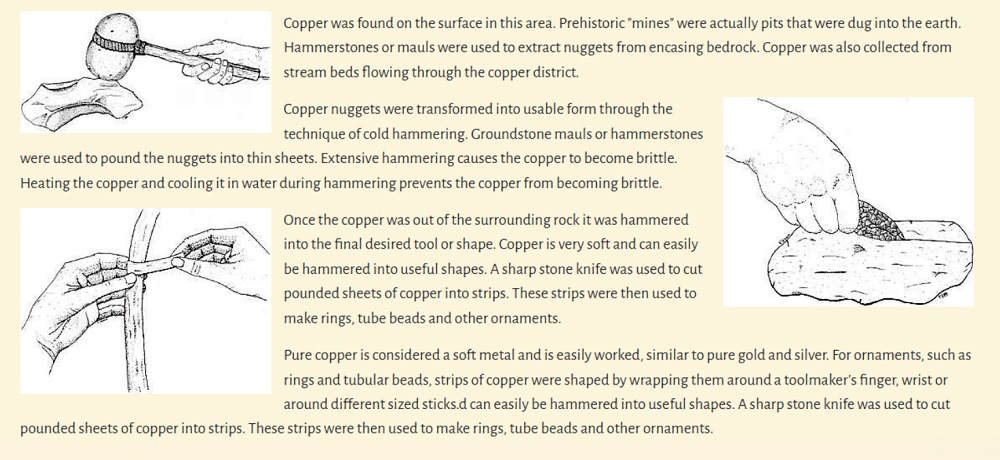
The Hammerstones or Mauls (lower right corner) were found along the Mississippi River and were donated to SMINC by Toney and George Prudhomme. These ancient artifacts are difficult to date and could be over 4000 years old. Because of the technique used to make the grooves, they are likely of the Archaic period which began about 6000 years ago and lasted until about 2500 years ago. References: The University of Wisconsin / LaCrosse has a research program in this area. use these links to find out more:
https://www.youtube.com/watch?v=xJ9OhLc5Log&t=63s
https://www.uwlax.edu/mvac/pre-european-people/native-technologies/native-copper/
https://www.uwlax.edu/mvac/pre-european-people/archaic-tradition/archaic-tradition-overview/